Hugging Face AutoTrain is a no-code tool for training models for Natural Language Processing (NLP), Computer Vision (CV), Speech, and Tabular tasks. W&B is directly integrated into Hugging Face AutoTrain, providing experiment tracking and config management. You only need a single parameter in the CLI command for your experiments. This page shows you how to enable W&B experiment tracking when you train a model with Hugging Face AutoTrain. You can capture metrics and configuration for every run without writing additional code. This page is for users who are already familiar with AutoTrain and want to add observability to their training workflows.Documentation Index
Fetch the complete documentation index at: https://wb-21fd5541-style-guide-models-integrations-20260527-015516.mintlify.app/llms.txt
Use this file to discover all available pages before exploring further.
Install prerequisites
Before you can train a model and log results to W&B, install the AutoTrain CLI and the W&B client library. Installautotrain-advanced and wandb.
- Command Line
- Notebook
pass@1 on the GSM8k Benchmarks.
Prepare the dataset
Before training, prepare your dataset so it matches the format AutoTrain expects. Hugging Face AutoTrain expects your CSV custom dataset to have a specific format to work properly. Your training file must contain atext column, which the training uses. The data in the text column must conform to the ### Human: Question?### Assistant: Answer. format. Review an example in timdettmers/openassistant-guanaco.
However, the MetaMathQA dataset includes the columns query, response, and type. First, pre-process this dataset. Remove the type column and combine the contents of the query and response columns into a new text column in the ### Human: Query?### Assistant: Response. format. Training uses the resulting dataset, rishiraj/guanaco-style-metamath.
Train using autotrain
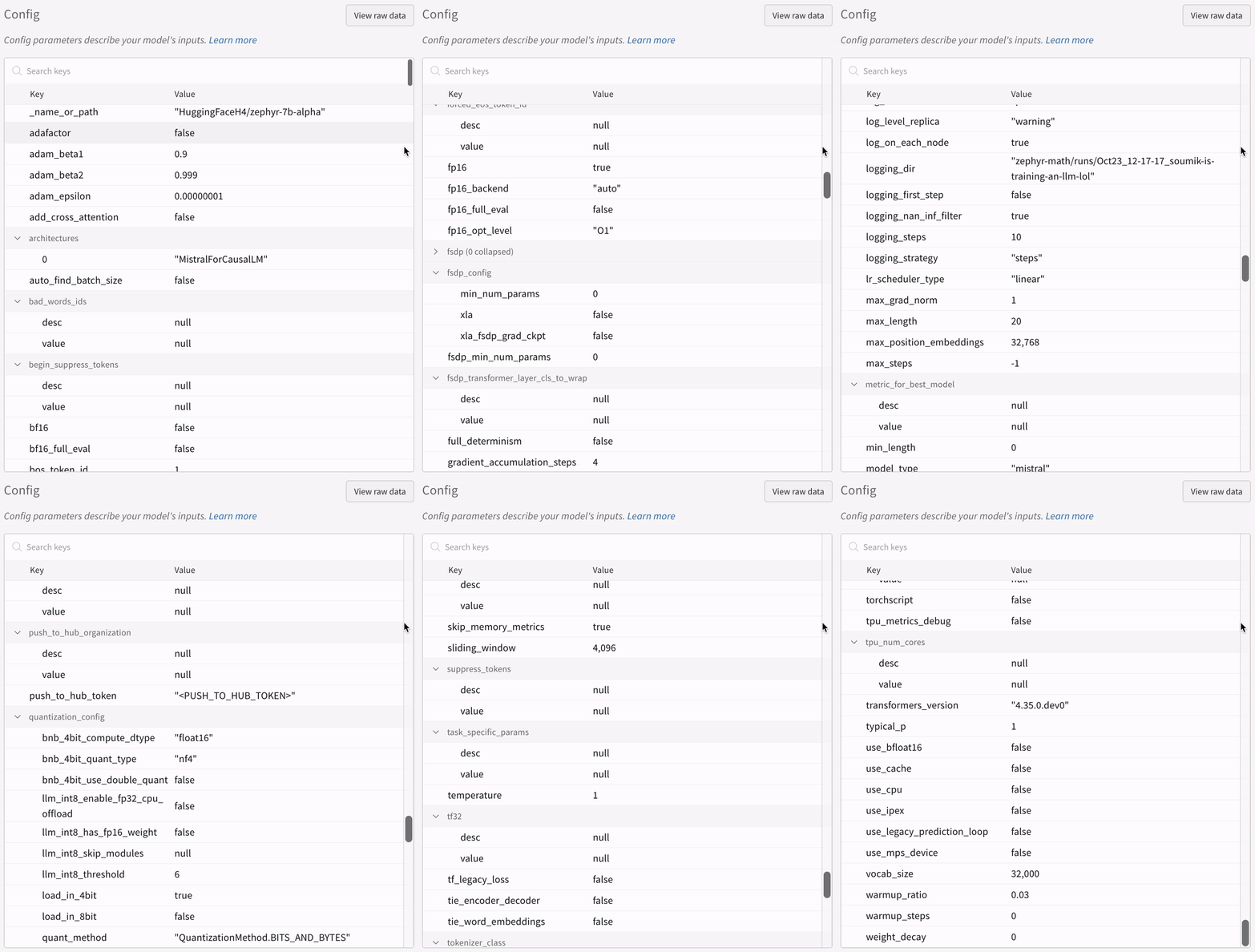
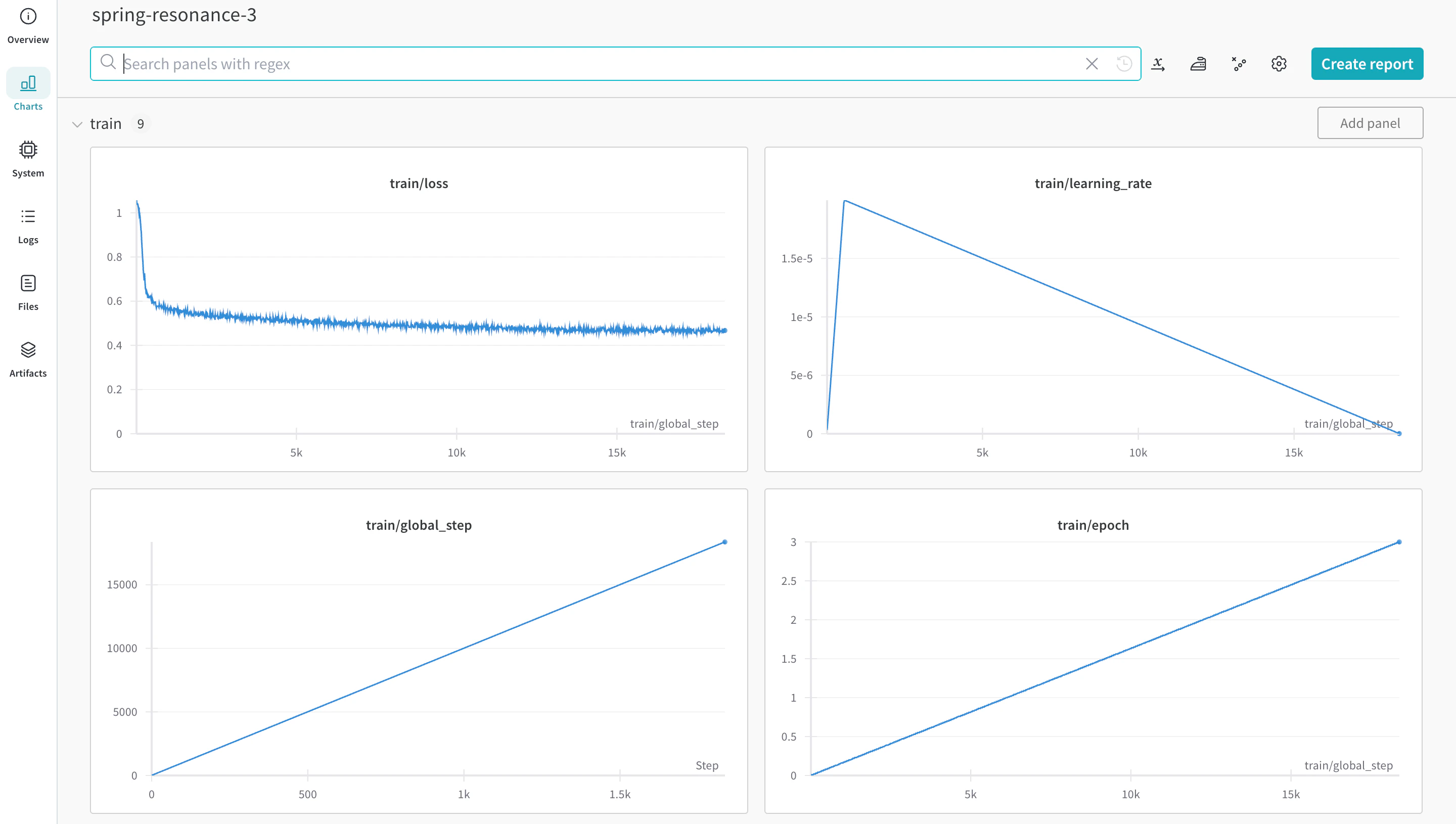
With your environment and dataset ready, you can now start training. Start training with the autotrain advanced from the command line or a notebook. Use the --log argument, or use --log wandb to log your results to a run. The --log wandb argument enables the W&B integration for this run.
Replace [HUGGINGFACE-TOKEN] with your Hugging Face access token and [HUGGINGFACE-REPOSITORY-ADDRESS] with the target repository address (for example, your-username/your-repo).
- Command Line
- Notebook