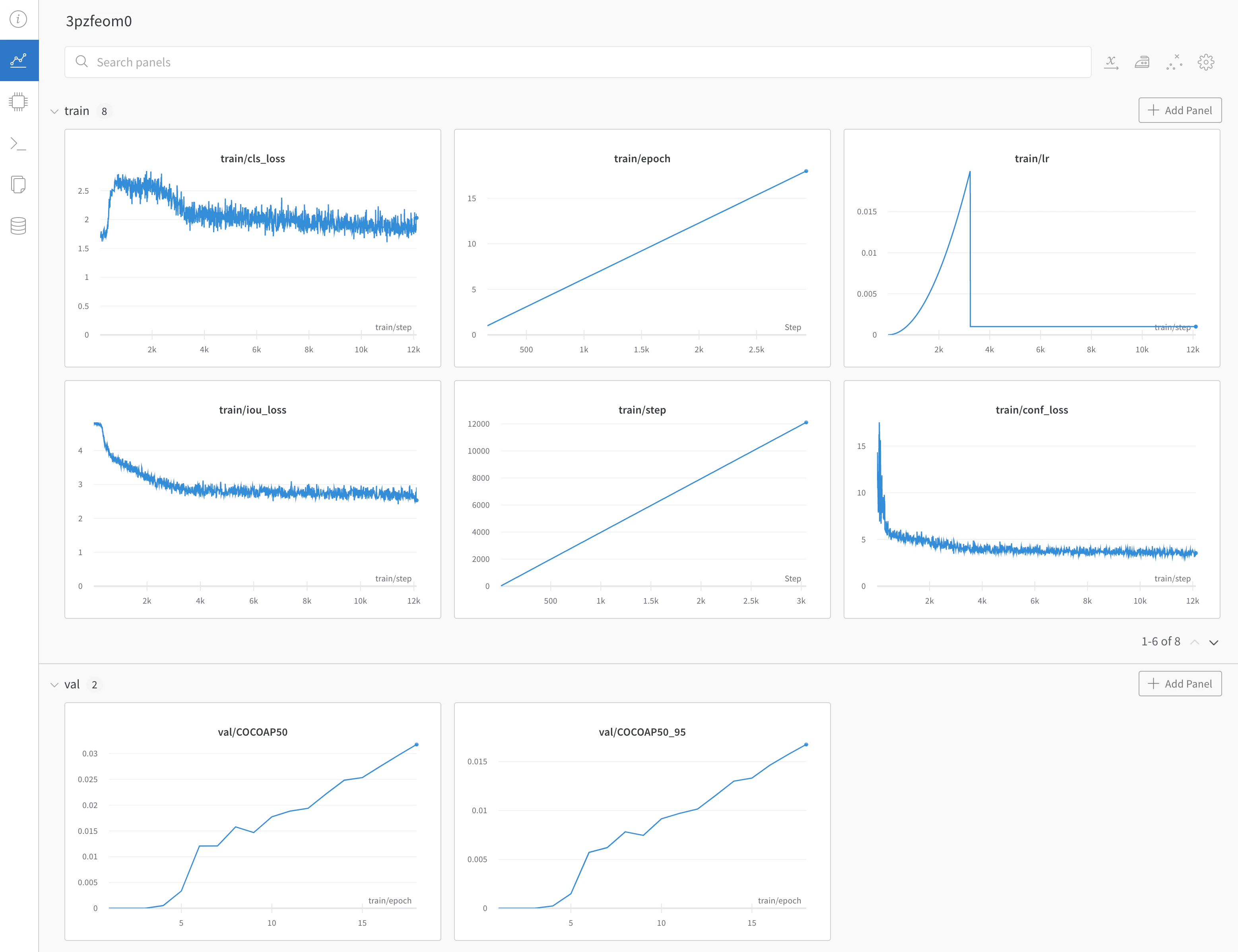
YOLOX is an anchor-free version of YOLO for object detection. You can use the YOLOX W&B integration to turn on logging of metrics related to training, validation, and the system, and to interactively validate predictions with a single command-line argument. This guide shows you how to authenticate with W&B, install the integration, and enable W&B logging when you train a YOLOX object detection model so you can track metrics and inspect predictions in the W&B UI.Documentation Index
Fetch the complete documentation index at: https://wb-21fd5541-style-guide-models-integrations-20260527-015516.mintlify.app/llms.txt
Use this file to discover all available pages before exploring further.
Sign up and create an API key
An API key authenticates your machine to W&B. You can generate an API key from your user profile.For a more streamlined approach, create an API key by going directly to User Settings. Copy the newly created API key immediately and save it in a secure location such as a password manager.
- Click your user profile icon in the upper right corner.
- Select User Settings, then scroll to the API Keys section.
Install the wandb library and log in
To install the wandb library locally and log in:
- Command line
- Python
- Python notebook
-
Set the
WANDB_API_KEYenvironment variable to your API key. -
Install the
wandblibrary and log in.
Log metrics
With thewandb library installed and your machine authenticated, you can enable W&B logging from the YOLOX training script.
Use the --logger wandb command-line argument to turn on logging with wandb. Optionally, you can also pass all of the arguments that wandb.init() expects. Prepend each argument with wandb-.
num_eval_imges controls the number of validation set images and predictions that W&B logs to tables for model evaluation.
Replace the following placeholders before you run the command:
[PROJECT-NAME]: The name of your W&B project.[ENTITY]: Your W&B entity (username or team name).[RUN-NAME]: A name for this training run.[RUN-ID]: A unique identifier for this run.[SAVE-DIR]: The directory where YOLOX saves checkpoints and logs.[NUM-IMAGES]: The number of validation images to log.[BOOL]: Whether to log checkpoints (trueorfalse).
Example
After your training run starts, YOLOX streams training, validation, and system metrics to your W&B project, where you can compare runs and inspect predictions. See the following example for what a populated dashboard looks like. See the example dashboard with YOLOX training and validation metrics.